
Issue #030: Will the future be human?
52 weeks - 2 TED talks a week - 104 TED talks per year - TEDx talks deconstructed on how they can help you as TPMs for your day-to-day
About this TPM Breakdown Series
52 weeks: 2 TED talks a week: 104 TED(x) talks deconstructed into summaries and actions you can apply in 7 days
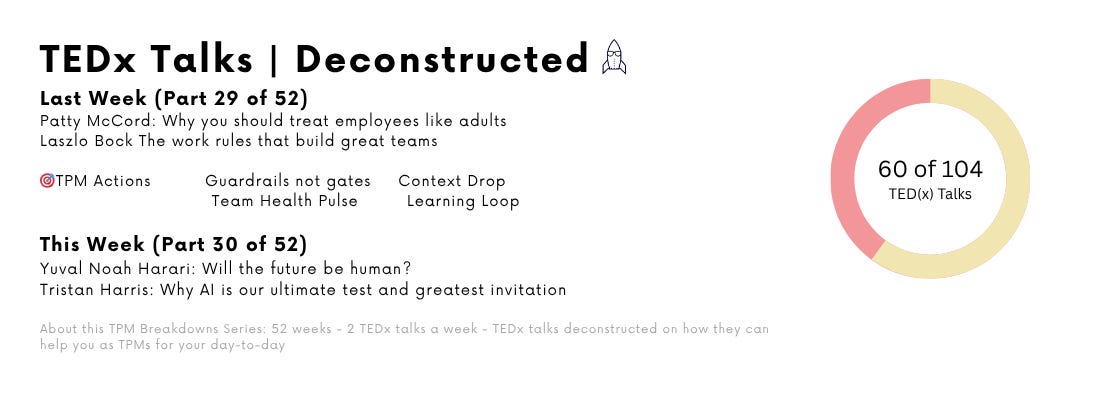
We're in Week 30: 60 of 104 TED(x) talks: 120 action items shipped so far.
Last Week’s Recap
The Data: High trust teams ship faster
Fun fact: arari at Davos 2018 warned that data would become the most valuable asset in the 21st century, concentrated in the hands of whoever builds the best algorithms. That warning is now the operating environment.
Why it matters for TPMs: AI programs inherit the data assumptions of whoever designed them. If you are not asking who controls the data and what it optimizes for, someone else already made that call.
This Week: Issue #030
This week focuses on: understanding what is actually at stake with AI (Harari) and refusing to repeat the mistakes of social media deployment (Harris).
Yuval Noah Harari: Will the future be human?
Summary: Harari argues that data is the defining resource of the 21st century, more valuable than land or machinery. Whoever owns the best algorithms and the most data will shape the future of humanity: economies, bodies, and minds. The scary version is not a robot uprising. It is a small group of humans who understand the data, and everyone else who does not.
Quote to remember: “In the 21st century, data is the most important asset.”
Why it matters for TPM: Every AI program you run is producing data about how work gets done. If your org is not treating that data as a strategic asset (version-controlled, owned, audited) you are building the next owner's leverage, not yours.
As a TPM for the next 7 days
Watch for:
AI outputs that nobody owns downstream
Datasets with no lineage or version history
Decisions made from model outputs without knowing what the model was trained on
ToDos:
Data Ownership Audit: For one AI initiative, answer three questions: Who owns the training data? Who owns the output data? Who can change what the model optimizes for? If you cannot answer all three, that is your first risk item.
Lineage Check: Add data provenance to one artifact this week. Where did it come from, when was it last updated, and what assumptions does it embed?
Tristan Harris: Why AI is our ultimate test and greatest invitation
Summary: Harris, the technologist who first exposed social media's attention extraction machine, returns to the TED stage with a harder argument: AI is not just more powerful than social media, it dwarfs every other technology combined. Because advances in general intelligence compound across every domain simultaneously. The mistake we made with social media was optimizing for the probable (engagement, addiction, division) while talking only about the possible (connection, voice, access). Harris calls for a narrow path: power matched with foresight, responsibility, and wisdom. Not inevitable. A choice.
Quote to remember: “We don't talk about the probable. What's actually likely to happen due to the incentives.”
Why it matters for TPM: TPMs are in the room when the probable gets decided. Not in the ethics review. In the sprint planning. In the data schema. In the rollout criteria. The probable is built in the backlog, not in the policy document.
As a TPM for the next 7 days
Watch for:
Launch criteria that only measure capability, not probable misuse
Features shipped without a rollback definition
“We’ll address that later” on alignment risks in high-velocity programs
ToDos:
Probable Scan: In your next program review, add one question: What is the most likely negative outcome if this feature behaves exactly as designed? Document it. Assign an owner.
Rollback Definition: For one active AI feature, write the rollback trigger. What metric, at what threshold, initiates a pull-back? If it does not exist, write it now.
Final Words
The data controls the future and the deployment path is a choice. Track data ownership gaps closed and rollback definitions written.
Check out the full series “TED Talks Deconstructed for TPMs”.
So long
Michi